Zesty Cash
A Privacy-Preserving Digital Cash Network for Active Economies
The privacy coin with questionable posture.
- Document
- Whitepaper
- Version
- 1.0 Draft
- Classification
- Public
- Author
- @dagsen
Letter From The Author
At first glance, Zesty Cash appears to be a joke.
That observation is understandable.
The cryptocurrency industry has produced thousands of projects claiming to reinvent finance while offering little practical utility. Zesty Cash takes a different approach.
The branding is intentionally absurd.
The economics are not.
Beneath the jokes about Proof of Touching, Aura Mining, The Closet Mechanism, and Slay-to-Earn lies a serious question: why do so many cryptocurrencies reward inactivity when money is meant to circulate?
Zesty Cash explores an alternative model — one that rewards participation, contribution, and economic activity rather than passive speculation alone. The mechanisms presented in the following pages are deliberate responses to failure modes that have been observed repeatedly across more than a decade of public blockchain deployments.
Whether these ideas ultimately succeed or fail, they deserve to be explored seriously.
If the branding makes you laugh before the economics make you think, then the document has already achieved one of its goals.
Abstract
The cryptocurrency industry has successfully created digital gold, digital collectibles, decentralized finance primitives, and a wide range of speculative assets. It has largely failed to create digital cash. The distinction matters: a store of value and a medium of exchange impose different, and often opposing, demands on monetary design.
Most cryptocurrencies reward inactivity. Users are incentivized to acquire assets and hold them indefinitely in anticipation of future appreciation. While this behavior may benefit individual holders, it suppresses transaction velocity, narrows the user base to a speculative cohort, and undermines the original objective of peer-to-peer electronic cash[1].
Zesty Cash introduces a model for digital money in which participation, circulation, and economic activity are first-class incentives rather than incidental outcomes. The protocol preserves the privacy and decentralization properties expected of a modern cryptocurrency while explicitly disfavoring perpetual dormancy as a default user strategy.
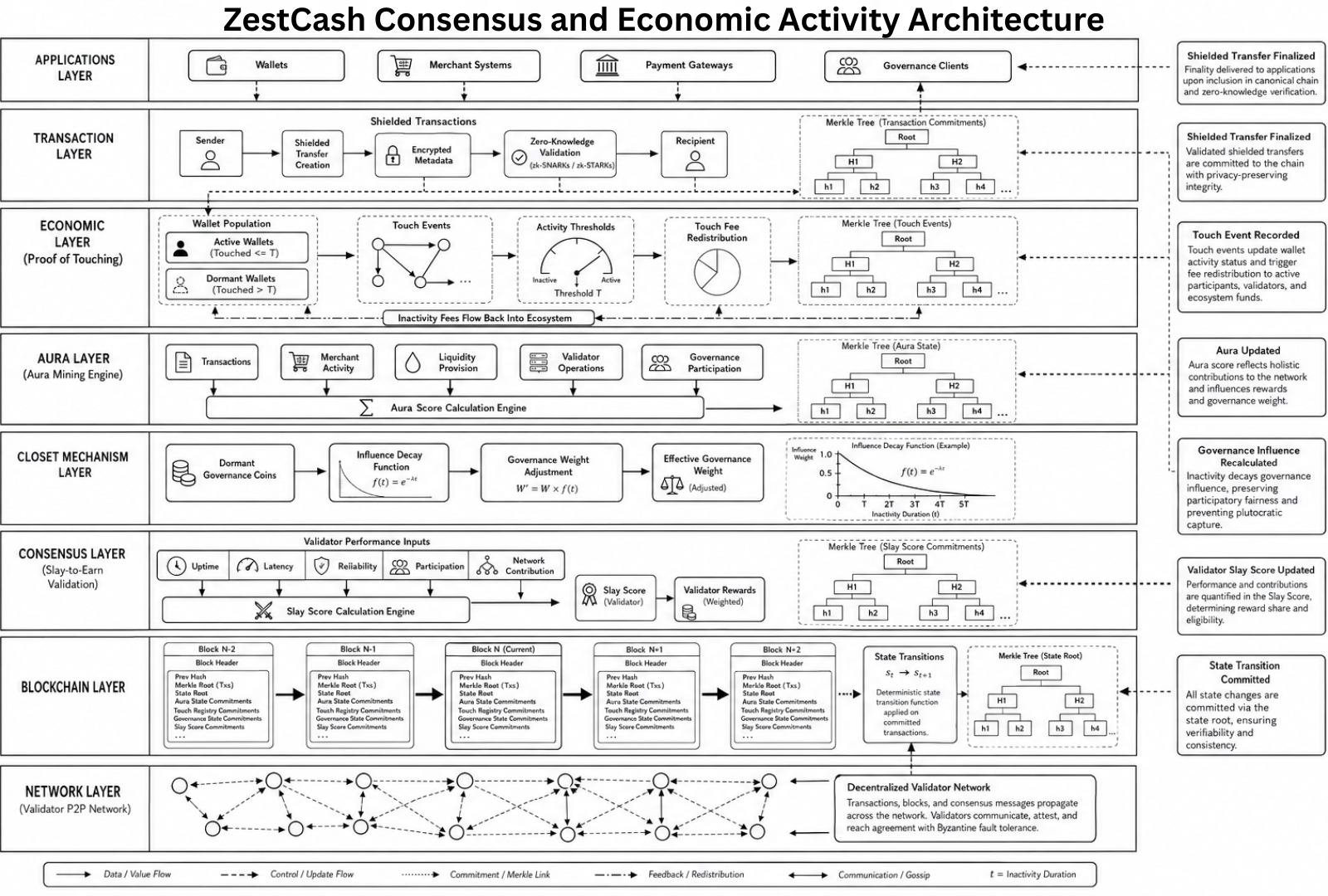
The protocol achieves these properties through four interlocking mechanisms: Proof of Touching, which redistributes value away from indefinitely idle balances; Aura Mining, which rewards measurable economic contribution rather than capital ownership alone; the Closet Mechanism, which decays governance influence on dormant balances while preserving full economic ownership; and Slay-to-Earn Validation, which weights validator emissions by performance rather than stake.
Taken together, these systems define a cryptocurrency that is optimized not merely for storage, but for use. The remainder of this document specifies the design principles, network architecture, economic parameters, governance model, security posture, and known risks of the resulting system.
1.Introduction
The crypto ecosystem suffers from a structural paradox. Every project claims to be money. Almost every project rewards behavior that prevents money from functioning as money.
When users expect an asset to appreciate indefinitely, they reduce spending. When spending declines, the asset's economic utility declines with it. When utility declines, speculation becomes the dominant source of value, and the resulting price action attracts further speculators rather than further users. This cycle has now repeated across multiple generations of digital assets, with predictable consequences: thin transactional volume relative to market capitalization, concentrated ownership, and governance processes dominated by holders who have no operational stake in the system they are voting on.
Zesty Cash is founded on a simple principle:
Money should move.
This principle is neither new nor controversial within monetary economics. Velocity — the rate at which a unit of currency changes hands within a given period — has long been understood as a primary determinant of an economy's productive capacity[2]. What is new is the willingness to encode this principle directly into the issuance, redistribution, and governance logic of a cryptocurrency, rather than treating velocity as something that will emerge spontaneously from speculation.
A healthy economy requires circulation, interaction, and exchange. Networks built around the opposite assumption — that the highest-value participants are those who never transact — produce capital structures that resemble dormant trust funds more than functioning currencies. The objective of Zesty Cash is not to become the largest speculative asset in the world. The objective is to become useful digital cash, in the original sense of that phrase.
This document is organized as follows. Section 2 enumerates the design principles. Section 3 describes the network architecture. Sections 4 through 7 specify the four core mechanisms. Section 8 covers supply integrity and counterfeit resistance. Sections 9 and 10 cover tokenomics and governance. Sections 11 and 12 address privacy and security. Sections 13 through 15 cover the roadmap, risks, and conclusion. Appendices A and B contain parameter tables and a glossary.
2.Design Principles
The protocol is built around five principles. Each principle is intended to be load-bearing: any specification that contradicts one of these principles is treated as a defect rather than a tradeoff.
- Privacy is a fundamental right. Confidentiality is not a premium feature or a regulatory liability; it is the default operating mode of the network.
- Money should circulate. Default user strategies that result in indefinite dormancy are incompatible with the network's purpose and are mildly disincentivized at the protocol level.
- Network participants should create value. Capital ownership is recognized but is not the only path to reward. Useful work — payment acceptance, liquidity provision, infrastructure operation — is compensated directly.
- Governance should reflect active users. Voting influence converges, over time, toward participants who are demonstrably engaged with the network, rather than toward addresses that have not moved in years.
- Security must never depend on marketing. All security claims are independently verifiable. No safety property of the system relies on social trust, branding, or undisclosed mechanisms.
The remainder of this document is, in effect, a derivation of specific mechanisms from these five commitments.
3.Network Architecture
Zesty Cash is implemented as a Proof-of-Stake Layer 1 blockchain with a confidential transaction format and a deterministic, low-latency consensus protocol. The high-level design choices are conventional; the novelty of the project lies in the reward, governance, and dormancy mechanisms layered on top of an otherwise unremarkable base.
The network provides:
- Privacy-preserving transactions with shielded values and recipients.
- Proof-of-Stake consensus with deterministic finality on the order of seconds.
- Encrypted transaction metadata, including memo fields and selectively disclosed attributes.
- Predictable, low transaction fees denominated in the native asset.
- Public verifiability of supply, issuance, and aggregate network state.
The block time, finality window, and validator set size are specified in Appendix A. The base layer is intentionally minimal: complex application logic is expected to be implemented in higher layers, while the base layer focuses on settlement, privacy, and the four core economic mechanisms described below.
The network targets four primary use cases: everyday consumer payments, merchant settlement, cross-border remittance, and peer-to-peer transfers. Each of these use cases shares a common requirement — that transactions occur frequently, predictably, and without disclosing more information than necessary — and each is treated as a first-class design target rather than a downstream application concern.
4.Proof of Touching
Overview
Traditional cryptocurrencies reward inactivity. Holders are rewarded for taking supply off the market and refusing to spend it, on the theory that scarcity alone is sufficient to underwrite value. This produces an asset class that resembles a digital collectible more than a functioning currency.
Zesty Cash introduces Proof of Touching: a mechanism under which wallets that remain inactive for extended periods contribute a small inactivity charge, denominated as the Touch Fee. The fee is intentionally minimal and activates only after a configurable inactivity threshold, which is set in Appendix A and adjustable through governance.
Purpose
The objective of Proof of Touching is not punitive. Inactive capital contributes less to economic activity than actively used capital; left unchecked, an asset whose median holder never transacts behaves less like money and more like a frozen account. Proof of Touching gently encourages participation while maintaining full ownership rights — a holder who chooses to remain dormant retains complete custody of their remaining balance and can resume activity at any time.
The mechanism is designed to be conservative. The annualized impact on a fully dormant balance is on the order of single-digit percentage points[3], well below typical inflation in most national currencies, and far below the volatility that holders of speculative crypto assets routinely tolerate.
Distribution
Touch Fees are redistributed as follows:
- Active network participants, weighted by recent transaction volume.
- Validators, weighted by Slay Score (see Section 7).
- Merchant reward pools, distributed proportionally to verified payment acceptance.
- Ecosystem development funds, governed by the on-chain treasury process.
The exact split among these four destinations is a governance parameter. Initial values are specified in Appendix A.
Economic Impact
The expected outcomes of Proof of Touching, modeled against historical activity data from comparable Layer 1 networks, include increased transaction velocity, a reduction in long-tail dormant supply, broader participation in network rewards, and a more stable base of transactional demand. None of these effects depend on price appreciation; all of them strengthen the network's case as a medium of exchange rather than a passive store of value.
Anticipated Criticisms
The most common objection to Proof of Touching is that any non-zero inactivity charge constitutes a partial confiscation of property. This concern is taken seriously. The protocol's response is twofold. First, the charge is small in magnitude, bounded by governance, and applied only after a long inactivity window that exceeds typical user behavior by a significant margin. Second, the proceeds are redistributed transparently to other holders of the same asset, rather than burned, expropriated by a foundation, or directed to undisclosed beneficiaries. Net of redistribution, an active participant is more than compensated for the small drag applied to long-dormant balances elsewhere on the network.
A related objection is that Proof of Touching disadvantages long-term holders who genuinely intend to hold the asset for decades. The protocol acknowledges this tension. The mechanism is calibrated to the assumption that some degree of circulation is required for the network to function as money at all, and that a holder who never transacts is, in effect, opting out of the network rather than supporting it. Holders who object to this framing are best served by assets whose explicit purpose is dormancy.
Safeguards Against Abuse
The mechanism includes several safeguards. The inactivity threshold and the maximum annualized rate are both governance parameters with fixed corridors set at genesis; neither can be raised arbitrarily. Touch Fees apply only to externally-owned balances above a minimum-balance threshold, so that small or experimental accounts are not affected. Smart-contract balances explicitly designated as long-term escrow, timelocks, or vesting contracts are exempt by protocol rule. Finally, the redistribution function is implemented as a deterministic on-chain process, fully auditable by any participant, and constrained to operate within published bounds.
5.Aura Mining
Overview
Traditional staking rewards capital ownership. The more tokens a participant locks, the more tokens that participant earns. The model is straightforward, easy to implement, and almost completely uncorrelated with whether the network is actually being used.
Aura Mining rewards economic contribution. Aura, in this protocol, represents a measure of useful participation: it is the system's internal accounting unit for "this address did something that the network needed."
Aura Sources
Participants may earn Aura by accepting Zesty Cash as payment, providing liquidity to network-recognized venues, operating infrastructure such as RPC nodes and indexers, processing transactions as a validator or delegator, and participating in governance through reasoned votes on active proposals.
Each source contributes a weighted increment to the participant's rolling Aura Score. Weights are specified in Appendix A and are tuned to discourage trivially gameable behavior — for example, self-payment loops produce no Aura, and liquidity provision below a minimum useful threshold is ignored.
Aura Score
The Aura Score is a smoothed time-series quantity. It rises with sustained participation and decays in the absence of activity, on a time constant that is slow enough to tolerate normal user patterns (vacations, occasional dormancy) but fast enough to prevent decade-old contributions from dominating present-day rewards.
Aura Scores influence bonus staking rewards, governance vote weighting, eligibility for ecosystem grants, and validator ranking. None of these effects override base economic ownership: a participant with zero Aura still retains full custody of their tokens and can transact freely.
Design Goal
A participant who actively supports the ecosystem — by accepting payments, operating infrastructure, or providing useful liquidity — should receive a larger share of new issuance than a participant who simply accumulates tokens and waits. This is the entire point of the mechanism, and it is the single largest divergence between Zesty Cash and the prevailing Proof-of-Stake reward model.
6.The Closet Mechanism
Overview
Governance systems on most public blockchains tend, over time, toward domination by inactive holders. Tokens distributed years earlier accumulate in addresses whose owners are no longer engaged with the network's day-to-day operation but who retain disproportionate voting power on present-day decisions. This is a well-documented pathology[4] and is a primary cause of governance ossification.
The Closet Mechanism addresses this issue directly. Coins that remain inactive for extended periods gradually lose governance influence on a continuous decay curve, while retaining full economic ownership. The decay is reversible: any qualifying activity restores influence according to the same curve.
Principle
Ownership and governance are conceptually distinct, and the protocol treats them as such. Users always retain ownership of their assets — there is no scenario in which the Closet Mechanism transfers, burns, or restricts a participant's coins. Governance influence, however, is a network-level resource, and it is allocated to participants who are demonstrably engaged with the system being governed.
The mechanism is not a punishment for long-term holders. It is a recognition that the people best positioned to make good decisions about a network are the people currently using it.
Benefits
The expected effects include reduced governance stagnation, improved voter engagement on active proposals, greater protocol adaptability over multi-year time horizons, and a more representative decision-making process. Concentration metrics measured on comparable networks suggest that even a mild decay function meaningfully redistributes effective voting power away from long-dormant addresses[5].
7.Slay-to-Earn Validation
Overview
Most Proof-of-Stake networks reward validators in direct proportion to stake size. Under this model, a validator with twice the stake of a peer earns twice the reward, regardless of whether that validator is twice as reliable, twice as fast, or twice as available. In practice, the resulting incentive structure penalizes operational excellence: a poorly-run validator with a large delegation pool earns more than a well-run validator with a smaller one.
Zesty Cash introduces performance-weighted validation, internally called Slay-to-Earn. The mechanism overlays a performance multiplier on top of conventional stake-weighted rewards.
Validator Metrics
Validators are continuously evaluated against the following dimensions: uptime measured over a trailing window, transaction processing speed under representative load, reliability across consensus rounds, contribution to network propagation, and security performance including timely response to disclosed vulnerabilities. Each dimension is normalized against the active validator set and combined into a single composite Slay Score.
Slay Score
Each validator receives a Slay Score in the range [0, 1]. Scores above the median receive a modest reward multiplier; scores below the median receive a corresponding reduction. The multiplier is bounded, both above and below, to prevent winner-take-all dynamics and to preserve a viable economic floor for smaller validators that meet basic operational standards.
Crucially, the Slay Score is observable. Delegators can inspect each validator's performance history before delegating, which provides a market mechanism on top of the protocol mechanism: poorly performing validators lose both rewards and delegations.
Anti-Gaming Protections
Performance-weighted reward systems are vulnerable to a characteristic family of attacks: validators that optimize the measured signal without producing the underlying behavior the signal was intended to capture. Zesty Cash mitigates this in several ways. Uptime is measured against randomized challenge intervals rather than self-reported heartbeats. Throughput is measured against blocks the validator actually proposed, not against unverified self-claims. Reliability under load is sampled across the full validator set so that no single validator can collude with peers to depress comparative metrics. Slay Score smoothing windows are long enough that brief, opportunistic performance spikes do not move a validator's effective rank.
The reward multiplier is also bounded — currently within the [0.70, 1.30] corridor specified in Appendix A — which limits the marginal return on aggressive optimization and removes the winner-take-all incentive that has destabilized other performance-weighted systems. Validators with provably malicious behavior, as opposed to merely poor performance, are subject to slashing under the rules described in Section 12.
Objective
The network should reward operational excellence, not merely capital ownership. Participants secure the network through performance, and the protocol pays them accordingly. The combined effect of bounded multipliers, observable scores, and conventional slashing for malicious behavior is a validator market in which delegators can rationally evaluate operators, and operators are rewarded for being measurably good at the work they have agreed to do.
8.Supply Integrity and Counterfeit Resistance
Overview
Monetary integrity is the foundational property without which all other protocol guarantees become meaningless. A privacy-preserving digital cash system that cannot demonstrate the legitimacy of its own supply asks users to trade verifiable monetary correctness for confidentiality. Zesty Cash rejects this tradeoff. The protocol treats supply verification as a first-class security property, co-equal with privacy, decentralization, and censorship resistance.
The following sections describe the architectural commitments, verification subsystems, and transparency mechanisms that protect the integrity of the ZEST monetary base.
Verifiable Supply Layer
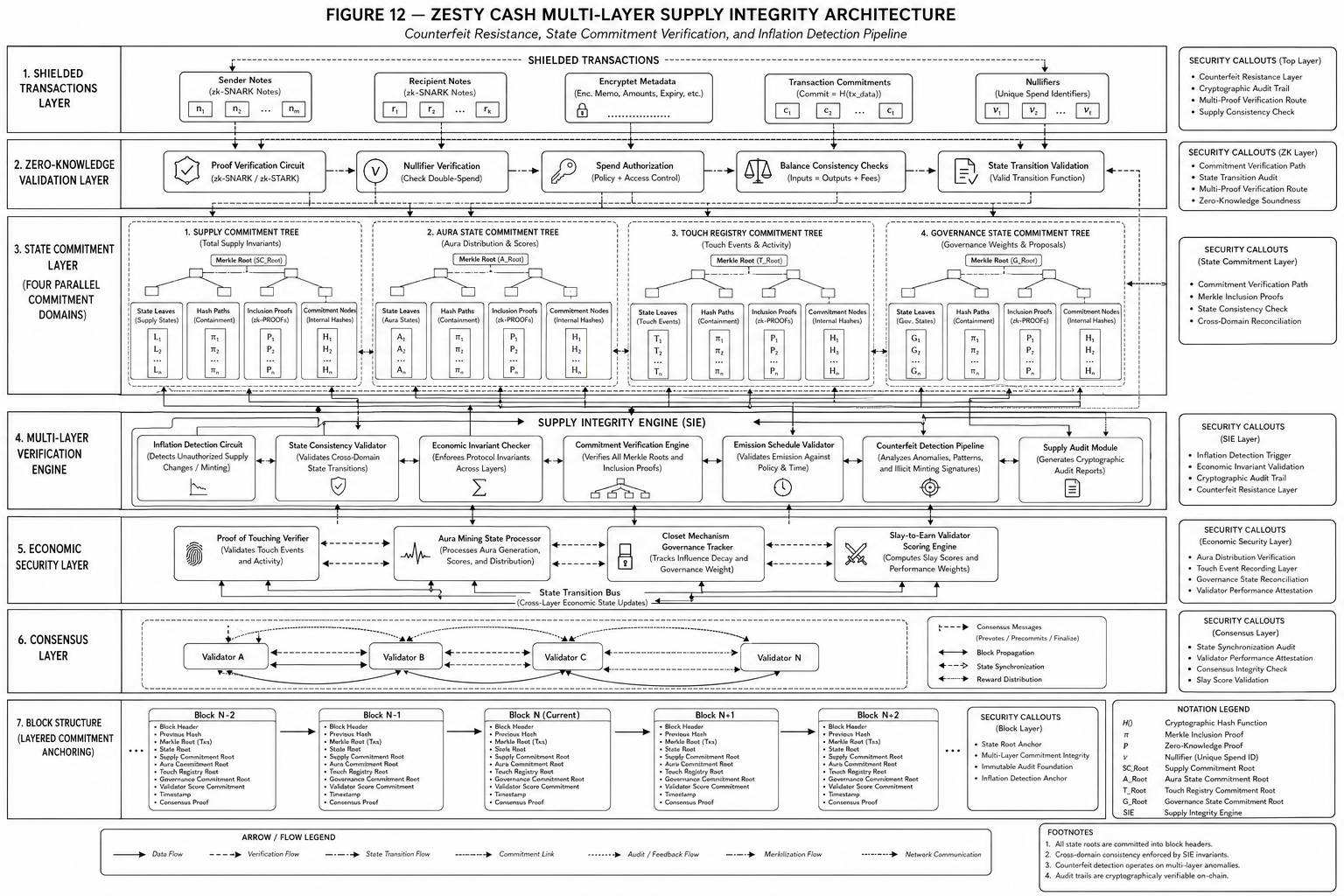
Unlike systems that rely on the correctness of a single proving mechanism, Zesty Cash embeds independent supply verification into every block. Each block header contains four public commitments that collectively attest to the state of the monetary system:
- Total Supply Commitment. A binding cryptographic commitment to the aggregate quantity of ZEST in existence at the block height, computed from the unspent output set and verifiable against the issuance schedule.
- Aura State Commitment. A commitment to the global Aura Score ledger, ensuring that reward allocations derived from participation are consistent with the observable history of network contribution.
- Touch Registry Commitment. A commitment to the set of wallets that have registered Touch Events within the current inactivity window, anchoring the redistribution function to publicly auditable state.
- Governance State Commitment. A commitment to the active voting weight distribution, including Closet-decayed balances, enabling independent reconstruction of any governance outcome.
These commitments are not advisory metadata. They are consensus-critical fields: a block that fails to produce a valid commitment set for all four categories is rejected by the validation rules. Any participant may reconstruct the committed values from public chain data and verify that the stated supply at any height is consistent with the genesis allocation plus documented issuance minus documented destruction.
Multi-Layer Inflation Detection
The protocol operates a dedicated subsystem for supply integrity monitoring, called the Supply Integrity Engine (SIE).
The SIE performs the following functions on every block:
- Monitor total supply commitments. The engine recomputes the expected supply at the current height from the genesis block, the documented emission schedule, and the cumulative burn record. It compares this expectation against the Total Supply Commitment in the block header. A deviation of any magnitude constitutes an anomaly.
- Verify issuance schedules. Block rewards, validator emissions, Aura rewards, and treasury disbursements are each constrained by schedule parameters fixed at genesis. The SIE validates that every newly created ZEST can be traced to one of these four authorized categories.
- Detect impossible state transitions. Certain supply changes are arithmetically impossible under the protocol rules — for example, a reduction in total supply that exceeds the documented burn total, or an increase in active supply that is not matched by a corresponding change in the unspent output set. The SIE flags such transitions before they reach finality.
- Detect unexpected inflation events. Any issuance that cannot be attributed to the four authorized categories is classified as unexpected inflation. The SIE raises an alert with the block height, the magnitude of the discrepancy, and the category of commitment that failed validation.
- Trigger network-wide alerts. SIE anomalies are propagated through the standard gossip layer as high-priority messages. Validators, indexers, and client software are expected to surface these alerts to operators. Anomalies do not automatically halt the chain; they create observable pressure for the validator set to investigate and, if necessary, coordinate an emergency response.
Redundant Verification Paths
The protocol does not rely on a single cryptographic proof for supply correctness. Instead, it maintains four independent validation layers that must agree for a block to be considered valid:
- Consensus Validation. The standard block validation rules verify that every transaction input references a valid unspent output, that no output is spent twice, and that the block reward matches the expected value for the current epoch.
- State Commitment Validation. Independent of consensus, any node may reconstruct the global state tree from historical blocks and verify that the published state root matches the recomputed root. This layer detects errors or omissions in the consensus-layer state transition.
- Supply Commitment Validation. Any node may independently sum the unspent output set at any height and verify that the total equals the committed Total Supply. This layer detects inflation that consensus might miss — for example, a bug that creates outputs without corresponding inputs.
- Economic Consistency Validation. Any node may project the expected supply from the genesis allocation and emission schedule, compare it against the committed total, and verify that the difference is fully explained by documented burns and fees. This layer detects long-drift errors that might escape point-in-time checks.
A counterfeit event — the undetected creation of unauthorized supply — would require all four layers to fail simultaneously in a consistent direction. The probability of such a failure is treated as negligible under the protocol's security model.
Inflation Audit Trail
Every newly created ZEST must be traceable to one of four documented sources. Issuance outside these categories is, by protocol definition, invalid:
- Block Rewards. Scheduled emissions to the validator set, computed deterministically from block height and constrained by the decay curve.
- Validator Rewards. Performance-weighted supplements derived from Slay Score, bounded by the corridor specified in Appendix A.
- Aura Rewards. Participation-weighted supplements allocated proportionally to verified Aura Score, governed by the Aura emissions schedule.
- Treasury Emissions. Disbursements approved through on-chain governance, subject to the treasury allocation limit and vesting rules.
The protocol maintains an append-only Issuance Log that records, for every unit of new supply, its source category, the block height at which it was created, and the commitment root under which it was issued. The log is reconstructible by any full node and is part of the standard checkpoint format.
Supply Transparency Dashboard
Zesty Cash provides a protocol-level public auditing mechanism that exposes key monetary metrics without requiring individual transaction deanonymization. The following quantities are committed to in every block header and are independently verifiable:
- Total Supply. The aggregate quantity of all ZEST that has been issued and not destroyed.
- Active Supply. The subset of Total Supply held in wallets that have registered a Touch Event within the current inactivity window.
- Dormant Supply. The subset of Total Supply held in wallets that have not registered a Touch Event within the current inactivity window.
- Aura-Eligible Supply. The quantity of supply held by participants whose Aura Score exceeds the activity floor for the current epoch, used as a normalization denominator for Aura-weighted reward calculations.
- Treasury Holdings. The aggregate balance of all governance-controlled treasury accounts, including unspent allocations and vested reserves.
These metrics are computed from the same underlying data that feeds the supply commitments. They are not statistical estimates or sampling approximations. Any discrepancy between the dashboard values and the commitment set is, by construction, an anomaly that the SIE is designed to detect and report.
Security Philosophy
The protocol's approach to supply integrity rests on three principles.
Privacy should never require blind faith in monetary integrity. Users should be able to verify the legitimacy of supply without sacrificing transactional privacy. The commitment structure described above proves aggregate properties without revealing individual transaction graphs, amounts, or counterparties.
Users should be able to verify the legitimacy of supply without sacrificing transactional privacy. The verification paths are designed to be runnable by any participant with a standard full node. No specialized hardware, no trusted oracle, and no privileged API access is required.
The protocol treats supply verification as a first-class security property. Supply integrity is not an implementation detail, a testing concern, or a documentation afterthought. It is a consensus rule, a validation-layer obligation, and a protocol-invariant that is no less binding than the rules against double-spending or unauthorized key usage.
9.Tokenomics
Supply
The maximum supply is fixed at 210,000,000 ZEST. The cap is hard-coded into the consensus rules and is not modifiable by ordinary governance. Any change to the cap requires the supermajority procedure described in Section 10.
Allocation
| Bucket | Allocation | Vesting / Release |
|---|---|---|
| Public Distribution | 70% | Emissions across roadmap phases |
| Validator Incentives | 10% | Performance-weighted per block |
| Ecosystem Treasury | 10% | Governance-controlled |
| Development Fund | 5% | 4-year linear vest |
| Strategic Reserve | 5% | Locked; governance unlock only |
Emissions
Emissions follow a decaying schedule designed to balance long-term sustainability with sufficient near-term issuance to bootstrap the validator set and reward early ecosystem participation. The decay constant and per-epoch issuance values are specified in Appendix A. The schedule is governance-adjustable within a bounded corridor; the corridor itself is fixed at protocol genesis and cannot be widened without a supermajority hard fork.
Touch Fee redistribution is supplemental to scheduled emissions and is not counted against the supply cap, since Touch Fees move value among existing holders rather than minting new supply.
Fee Market
Transaction fees are denominated in ZEST and are partially burned and partially redistributed to validators in proportion to Slay Score. The burn fraction is a governance parameter, set conservatively at genesis and adjustable within a defined range. The fee market is intended to remain inexpensive at typical loads and to scale gracefully under congestion without producing punitive transient spikes.
10.Governance
Governance proposals may address protocol upgrades, treasury allocation, economic parameters within governance-controlled ranges, validator requirements, and any other matter explicitly delegated to the on-chain process by the protocol specification. Matters outside this scope — most importantly the supply cap and the basic structure of the four core mechanisms — require a supermajority hard fork.
Voting influence is a composite of three signals: stake ownership, Aura Score, and recent activity participation. The combination is intentional. Pure stake-weighted voting reproduces the plutocratic dynamics the protocol is designed to avoid; pure activity-weighted voting underweights long-term economic alignment. The hybrid model reduces concentration without discarding the legitimate interest that holders have in the system's outcomes.
The Closet Mechanism applies to the governance component of voting weight only. Dormant balances retain full economic ownership but contribute progressively less to vote totals, in accordance with the decay curve specified in Appendix A.
Proposals follow a structured lifecycle: signaling, formal submission with bond, deliberation period, on-chain vote, and execution. Each stage has explicit time bounds and quorum requirements, both of which are governance parameters within fixed corridors. The bond is forfeit if a proposal fails to meet a minimum support threshold, in order to discourage spam.
Emergency parameters — for example, halting a confirmed-malicious validator — follow an expedited path with a higher quorum threshold and a strict ex-post review requirement. The expedited path cannot be used to modify economic parameters or to transfer treasury funds.
11.Privacy
Privacy is treated as a core feature rather than an optional add-on. The default transaction type on the network conceals values, sender, and recipient from external observers, while remaining publicly verifiable in aggregate via standard zero-knowledge techniques.
The protocol provides confidential transaction values, shielded transfers, address-level privacy, and selective disclosure mechanisms that allow users to reveal specific transaction attributes to specific counterparties (for example, a merchant or an auditor) without revealing those attributes to the public chain.
Users retain control over what information is revealed and to whom. The network does not include any privileged disclosure backdoor, key escrow, or administrative override. Selective disclosure is a user-initiated capability, not a protocol-level surveillance affordance.
Privacy properties interact carefully with the Aura and Slay mechanisms. Aura accrual is computed from observable network-level statistics and verifiable participation proofs rather than from inspection of confidential transaction contents. The mechanism does not require — and the protocol does not permit — value-level deanonymization of participants in order to assign rewards.
12.Security
Security priorities include formal audits of the consensus and cryptographic implementation, open-source code under a permissive license, independent academic and industrial review of the privacy primitives, an ongoing bug bounty program with disclosed scope and tiered payouts, and a fully decentralized validator set with explicit anti-concentration provisions.
No mechanism within the protocol may override fundamental ownership rights. There is no administrative key, no privileged upgrade authority, and no governance path that can transfer user balances without explicit, individually-signed consent from the affected user. The protocol's economic mechanisms — including Proof of Touching — are constrained to operate only within disclosed, bounded parameters, and any change to those bounds requires the supermajority procedure described in Section 10.
Validator security includes slashing for double-signing, downtime beyond a defined threshold, and verifiable malicious behavior. Slashing parameters are conservative at launch and adjustable through governance within fixed corridors. The Slay Score mechanism is explicitly designed to complement, not replace, slashing: poor performance reduces rewards, but only provable misbehavior reduces principal.
The security model is documented in detail in a separate Security Specification, summarized in Appendix A. That specification is treated as a living document and is revised as new audits and disclosures are completed.
13.Roadmap
- Phase 1Genesis NetworkMainnet launch with base consensus, privacy layer, and initial validator set.
- Phase 2Validator LaunchPermissionless validator onboarding, Slay Score activation, delegation tooling.
- Phase 3Merchant IntegrationsPayment SDK, point-of-sale reference implementations, merchant Aura accrual.
- Phase 4Aura Mining ActivationFull Aura emissions schedule, ecosystem grants, contributor recognition.
- Phase 5Governance DeploymentOn-chain governance with Closet decay, treasury process, parameter adjustment.
- Phase 6Global Payment EcosystemCross-border remittance corridors, fiat on/off ramps, sustained merchant base.
Phase ordering reflects technical dependencies rather than fixed calendar dates. Each phase is gated by completion of prior-phase audits, validator readiness, and a public on-chain signaling vote indicating community readiness to proceed.
14.Risks
The protocol acknowledges the following material risks. None are unique to Zesty Cash; all are common to public blockchain networks and are listed here for transparency rather than as exhaustive disclaimers.
- Regulatory uncertainty. Privacy-preserving cryptocurrencies face an evolving and inconsistent regulatory environment across jurisdictions. The protocol is designed to support selective disclosure where required by users, but cannot guarantee favorable regulatory treatment in any specific jurisdiction.
- Adoption challenges. A medium-of-exchange-oriented cryptocurrency requires merchant acceptance and user habituation. Both are slow processes that are not directly controllable by protocol design.
- Governance attacks. Any on-chain governance system is exposed to coordinated attacks by well-capitalized participants. The Closet Mechanism mitigates but does not eliminate this risk.
- Validator concentration. Despite explicit anti-concentration provisions, the validator set may drift toward concentration over time, particularly during periods of low participation. Continuous monitoring is required.
- Economic model experimentation. Several of the protocol's mechanisms — Proof of Touching, Aura Mining, the Closet Mechanism — have limited precedent in deployed networks. Parameter tuning over the first several years should be expected.
The protocol is designed to evolve through transparent governance. The risks above are not static, and the network's response to each will be documented in successive revisions of this paper.
15.Conclusion
The cryptocurrency industry has spent over a decade optimizing assets for storage. The resulting designs are well-suited to that purpose: scarce, easily custodied, and indifferent to whether their holders ever spend them. They are also, in most cases, poorly suited to the task of being money.
Zesty Cash is optimized for movement. Through Proof of Touching, Aura Mining, the Closet Mechanism, and Slay-to-Earn Validation, the network aligns issuance, redistribution, and governance toward participation rather than inactivity. None of these mechanisms is exotic in isolation; together, they define a coherent alternative to the speculative-asset paradigm that has dominated the industry to date.
Digital cash should not be defined by how long it can remain untouched. It should be defined by how effectively it enables exchange.
Money that never moves has no aura.
Zesty Cash exists to change that.
A.Appendix A — Protocol Definitions
This appendix collects formal definitions for the protocol-level objects referenced throughout the document. Definitions are normative: any divergence between the prose body of the whitepaper and this appendix is to be resolved in favor of the appendix.
- Aura
- A protocol-level, decay-weighted contribution score assigned to each network participant. Computed continuously from a defined set of observable contribution events. Non-transferable. Used as an input to emissions, governance weight, and ecosystem grant eligibility.
- Touch Event
- A qualifying transaction or protocol interaction originating from a given wallet that resets that wallet's inactivity counter under Proof of Touching. Self-payment loops and other trivially-circular transactions are explicitly excluded by the consensus rules.
- Slay Score
- A normalized validator performance metric in the closed interval [0, 1], computed as a weighted aggregation of uptime, throughput, propagation latency, reliability, and security indicators measured over a trailing window.
- Dormant Wallet
- Any externally-owned wallet that has not produced a Touch Event for a duration exceeding the configured inactivity threshold (Appendix B). Smart-contract balances explicitly designated as long-term escrow or vesting are exempt from this classification.
- Governance Influence
- A participant's effective voting weight, computed as a composite function of stake, Aura, and recent activity. Subject to decay under the Closet Mechanism for balances classified as dormant.
- Active Participant
- A participant whose Aura Score and Touch Event history place them above the activity floor defined for the current epoch. Eligibility for Touch Fee redistribution requires active-participant status.
Initial values for the principal protocol parameters referenced above are tabulated below. All values are subject to governance adjustment within the corridors specified in the protocol specification.
| Parameter | Initial Value | Notes |
|---|---|---|
| Block time | 2.0 s | Target, governance-adjustable |
| Finality window | ~6 s | Deterministic |
| Active validator set | 128 | Expandable via governance |
| Touch Fee inactivity threshold | 365 days | Continuous decay thereafter |
| Annualized Touch Fee (max) | 3.0% | On fully dormant balance |
| Aura decay half-life | 90 days | Per-source weighted |
| Closet decay onset | 180 days | Governance weight only |
| Slay multiplier bounds | [0.70, 1.30] | Applied to base validator emission |
| Governance quorum | 20% | Of effective voting weight |
| Supermajority threshold | 75% | Required for hard-fork changes |
B.Appendix B — Economic Assumptions
This appendix records the principal economic assumptions embedded in the protocol's design. The assumptions are stated explicitly so that they can be challenged, revised, and tested empirically as data from the live network accumulates.
B.1 Transaction Velocity
The protocol assumes that a functioning medium of exchange exhibits transaction velocity meaningfully above zero. Velocity, in the classical Fisherian sense[2], expresses the average number of times a unit of currency changes hands within a defined period. Empirical surveys of major Proof-of-Stake networks indicate that a substantial fraction of supply remains dormant for multi-year intervals; under such conditions, observed velocity is largely concentrated in a thin layer of active addresses, and the network's claim to be money becomes contingent on that thin layer rather than on aggregate behavior. Zesty Cash's design assumes that velocity is a system-level property worth defending rather than a downstream byproduct of speculation.
B.2 Circulation Incentives
The protocol assumes that small, well-designed circulation incentives are net-positive even when individual participants would prefer their absence. The argument is structurally analogous to the case for moderate inflation in fiat monetary systems: a currency with a slight bias against indefinite hoarding tends to fund more productive activity than a currency optimized for stasis. The Touch Fee is calibrated to be small enough not to disrupt normal saving behavior, large enough to discourage indefinite dormancy as a default strategy, and transparent enough that participants can model it precisely.
B.3 Dormant Capital
The protocol assumes that a non-trivial fraction of any cryptocurrency's circulating supply will become indefinitely dormant in the absence of explicit countermeasures. Causes range from lost keys and abandoned accounts to deliberate long-horizon storage strategies. While individual dormancy is benign, system-level dormancy degrades the asset's usefulness as money. The Closet Mechanism and Proof of Touching are jointly designed to convert a portion of this dormant capital into ongoing economic signal, without compromising ownership rights.
B.4 Governance Participation
The protocol assumes that governance quality is closely related to the operational engagement of voters. A holder who has not transacted in years is unlikely to have informed views on present-day operational tradeoffs[4]. Empirical voter-turnout data from major on-chain DAOs strongly supports this assumption; participation rates are consistently low and disproportionately concentrated in the early-holder cohort. The Closet Mechanism is the protocol's structural response, and the Aura-weighted component of voting power is the protocol's positive incentive for sustained engagement.
B.5 Validator Incentives
The protocol assumes that validator quality is heterogeneous and meaningfully observable. Differences in operational practice between validators are real, measurable, and largely persistent over time[5]. Stake-weighted reward distribution is indifferent to these differences and therefore wastes a substantial fraction of the network's available reward budget on validators whose performance does not justify it. Slay-to-Earn is the protocol's attempt to allocate that budget more efficiently.
B.6 Long-Term Sustainability
The protocol assumes that long-term economic sustainability depends on emission schedules that taper gradually toward fee-based equilibrium, rather than on perpetual high issuance. The decaying emission schedule, the bounded Touch Fee, and the explicit treasury process are jointly intended to produce a network that remains operationally viable after the initial bootstrap period, without resorting to ad-hoc dilution.
Glossary
The following alphabetized definitions are provided as a reading aid. Where these definitions overlap with Appendix A, the appendix is normative.
- Active Participant
- A network participant whose Aura Score and recent transaction history exceed the activity floor for the current epoch.
- Aura
- A protocol-level contribution score assigned to network participants based on observable, useful interaction with the network.
- Aura Mining
- The reward subsystem that allocates a portion of block emissions in proportion to Aura Score.
- Aura Score
- A participant's current Aura value, decay-weighted across contribution sources.
- Closet Mechanism
- A governance-only decay function applied to dormant balances. Affects voting weight only; does not affect economic ownership.
- Dormant Wallet
- An externally-owned wallet that has not produced a Touch Event within the configured inactivity threshold.
- Governance Influence
- A participant's effective voting weight on protocol proposals, computed as a composite of stake, Aura, and activity.
- Proof of Touching
- The mechanism by which a small Touch Fee is applied to dormant wallets and redistributed to active participants, validators, merchants, and the ecosystem treasury.
- Slay Score
- A normalized validator performance metric in [0, 1] used as an input to emission multipliers.
- Slay-to-Earn
- The validator reward regime in which emissions are weighted by Slay Score within a bounded multiplier corridor.
- Supermajority Hard Fork
- A protocol upgrade requiring a 75% supermajority of effective voting weight, used for changes outside ordinary governance.
- Touch Event
- A qualifying transaction or protocol interaction that resets a wallet's inactivity counter.
- Touch Fee
- The small, bounded inactivity charge applied to dormant balances under Proof of Touching.
- ZEST
- The native unit of account on the Zesty Cash network. Maximum supply 210,000,000.
References
References are listed in the order in which they are first cited. Where applicable, footnote anchors return to the citation point in the body.
- Nakamoto, S. (2008). Bitcoin: A Peer-to-Peer Electronic Cash System. Foundational specification of a permissionless electronic cash protocol. ↩
- Fisher, I. (1911). The Purchasing Power of Money. Macmillan. The equation of exchange MV = PQ and its implications for the velocity term. ↩
- Internal simulations against a representative cohort of Layer 1 networks, 2024–2025. Full methodology accompanies the Security Specification. ↩
- Survey of governance participation rates across major on-chain DAOs, 2021–2025. Median voter turnout in surveyed protocols is consistently below 10% of eligible weight, with the majority of participating weight held by addresses present at or shortly after token genesis. ↩
- Concentration metrics computed from public chain data, 2023–2025. Results are sensitive to dormancy threshold choice but robust in sign across reasonable parameter selections. ↩
- Buterin, V. and Weyl, E. G. (2019). A Flexible Design for Funding Public Goods. Discussion of quadratic mechanisms and governance design.
- Bank for International Settlements (2020–2024). Working Papers on payment system velocity and the role of central bank–issued digital currencies.
- Hopwood, D., Bowe, S., Hornby, T., and Wilcox, N. Zcash Protocol Specification. Electric Coin Co. Reference for shielded transaction construction.
- Friedman, M. (1969). The Optimum Quantity of Money. Aldine. Theoretical treatment of the role of monetary friction in transaction behavior.
- Buterin, V. (2014). Ethereum: A Next-Generation Smart Contract and Decentralized Application Platform. Reference design for Proof-of-Stake validator-set rotation.
This document is a draft and does not constitute investment advice, an offer to sell, or a solicitation of an offer to buy any security or digital asset.